

Solutions
Securely accept, manage, and make payments through one point of integration



Home to 102 million people, Vietnam is the fastest-growing economy in Southeast Asia according to the World Bank, boasting a GDP of US$476.39 billion in 2024. Once cash-heavy, Vietnam has since undergone a technological transformation that favours digital methods such as domestic transfers and digital wallets.
Vietnam’s transition from a cash-heavy to a digital-first economy is progressing steadily. In line with Prime Minister Nguyen Xuan Phuc’s National Financial Inclusion Strategy until 2025 and the State Bank of Vietnam’s Action Plan to implement the strategy, Vietnam has become highly digitalised, maturing from a fragmented landscape of standalone apps into a consolidated ecosystem.
Given the implementation and rapid adoption of the national real-time payment (RTP) solution VietQR, as well as the digitalisation of traditional banking services, it comes as no surprise that Vietnam recorded a peak of US$21 billion in e-commerce transactions in 2024, second only to Indonesia in Southeast Asia, according to the latest edition of 2C2P’s commissioned InfoBrief from IDC.
Over 70% of Vietnamese adults own a financial account, with at least 62% using digital payments regularly. Coupled with the fact that 80% of the Vietnamese population has Internet access, the country is poised to embrace the latest technological advancements in the payments ecosystem.
In this article, we explore Vietnam’s most popular payment methods, including:*
*Note: While these payment methods are ranked, it must be noted that cards, domestic payments, and digital wallets constitute very similar percentages of the total e-commerce transaction volume in 2024.
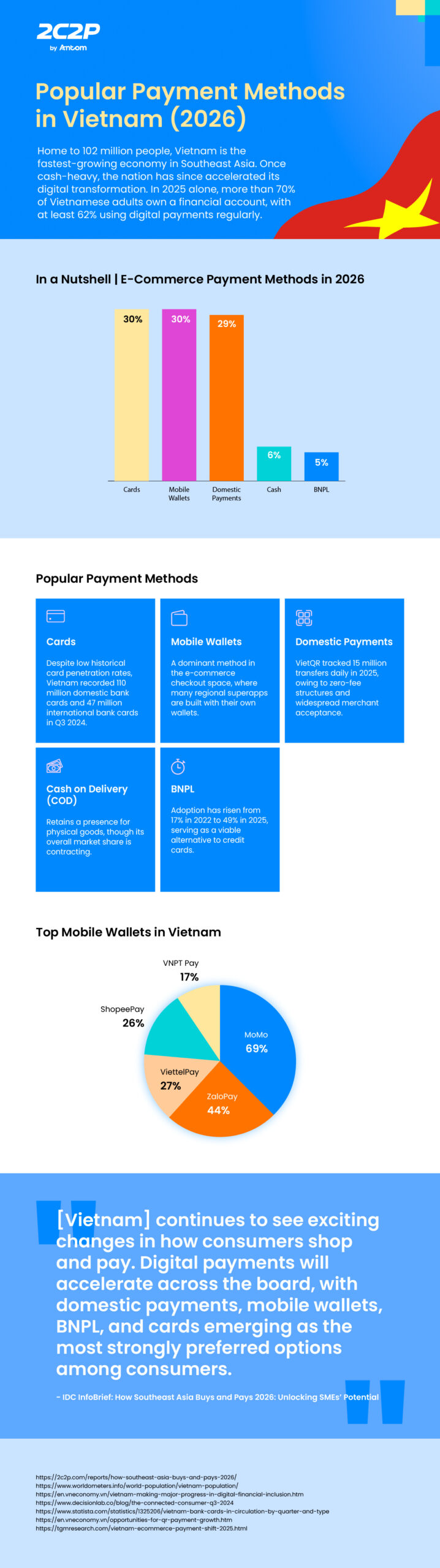
Cards emerge as Vietnam’s top preferred payment method for e-commerce, constituting an estimated 30% (US$9.9 billion) of e-transactions in 2026, according to 2C2P’s IDC InfoBrief 2026. This figure is expected to increase to 31% (US$15.81 billion) of e-commerce transactions by 2029.
This is despite Vietnam historically recording low card penetration rates, which have steadily improved in parallel with Vietnam’s cashless payment ambitions. In fact, Statista notes that in Q3 2024, Vietnam recorded 110 million domestic bank cards and 47 million international bank cards, marking a significant increase from the year’s preceding quarters.
In general, card usage in Vietnam operates on a dual track. As domestic debit cards are linked directly to local bank accounts, they are widely used for everyday digital spending and digital wallet top-ups. As for credit cards, they are largely utilised by a smaller, affluent urban segment for premium retail, travel, and international cross-border shopping.
This is corroborated by Visa’s Green Shoots Radar Report 2025, which highlights that Vietnam’s growing population of young, affluent consumers has increasingly utilised payment cards with travel-related benefits to fund premium experiences, ranging from travel and shopping to wellness and dining. While credit cards do not primarily drive day-to-day transaction volume, they still see notable usage for big-ticket e-commerce transactions.
Digital wallets are tied with cards, taking an estimated 30% (US$9.9 billion) of the overall e-commerce transaction share in 2026, according to 2C2P’s IDC InfoBrief 2026. This figure is projected to rise to 33% (US$16.83 billion) by 2029.
Digital wallets are notable for having bypassed traditional banking infrastructure to bring millions of Vietnamese consumers into the digital economy. In particular, digital wallets are heavily used by the young and tech-savvy populations of Ho Chi Minh City and Hanoi, where more merchants accept mobile payments. In 2025, over 60% of users in these two cities owned at least two digital wallet apps on their smartphones.
Aggressive promotional ecosystems and social commerce integrations have also contributed to digital wallets’ popularity.
Below are the top digital wallets used in Vietnam as of Q3 2024, according to Decision Lab:
Of these options, MoMo stands out for having evolved from a simple digital wallet to a definitive superapp. Recording over 31 million users in 2025, MoMo has become an all-in-one app for Vietnamese consumers to buy groceries, pay bills, make peer-to-peer (P2P) transfers, apply for microloans and insurance, invest, and trade.
As for ZaloPay, it taps into the user base of the parent Zalo messaging app, having grown from the app’s efforts to simplify peer-to-peer transfers and retail checkouts.
Given the importance of digital wallets to Vietnam’s e-commerce landscape, merchants need to integrate them to drive growth.
Domestic payments rank third, making up an estimated 29% (US$9.57 billion) of e-commerce transactions in 2026, according to 2C2P’s IDC InfoBrief 2026. They are expected to grow significantly to 30% (US$15.3 billion) by 2029.
The growth of domestic payments in Vietnam is primarily attributed to the National Payment Corporation of Vietnam’s (NAPAS) launch of VietQR, which began with 14 banks in 2021. Since the introduction of VietQR, Vietnamese consumers and merchants alike have enjoyed the 24/7, zero-fee, and instant settlement method of transferring funds instantly across different banks by scanning a single, standardised QR code.
In essence, VietQR has revolutionised domestic bank transfers, transforming them into a primary e-commerce payment method in Vietnam. In 2025 alone, NAPAS handled at least 15 million VietQR transfer transactions daily, with total annual transaction value reaching around VND40 trillion (US$1.54 billion).
Following the trend of cross-border RTP linkages initiated by Singapore, Malaysia, and Thailand, NAPAS launched VietQRPay in early 2025. Similar to its predecessors, VietQRPay aims to form linkages with Asia-Pacific countries to facilitate cross-border real-time payments. In December 2025, the first of such linkages was forged between Vietnam and China, enabling Vietnamese and Chinese consumers to pay in both countries via their respective QR codes.
Cash has not been completely phased out, contributing an estimated 6% (US$1.98 billion) of total e-commerce transactions in 2026, according to 2C2P’s IDC InfoBrief 2026. While its market share is actively contracting, COD remains a notable payment method in Vietnam’s e-commerce landscape. 2C2P’s IDC InfoBrief 2026 notes that at least 33% of surveyed small and medium enterprises (SMEs) reported high case usage in 2025, attributed to data security & fraud concerns, integration complexity, and a perceived inaccessibility of digital payment options.
Over on the consumers’ end, a survey conducted by TGM Research for its E-Commerce Insights 2025 found that up to 35% of Vietnamese consumers still prefer cash on delivery (COD) for certain online purchases. This enduring preference for cash is rooted in consumer psychology, with many Vietnamese shoppers continuing to value the manual process of verifying the condition and authenticity of their purchases before making payment.
However, the tide is turning against cash. As mentioned earlier, aggressive digital financial inclusion campaigns by the State Bank of Vietnam, along with the ease of VietQR and the convenience of digital wallets, have steadily eroded cash dominance.
While merchants must still offer COD to capture maximum market share today, this may not be as important in the near future, with 2C2P’s IDC InfoBrief 2026 projecting that cash would drop to 0% of total e-commerce transactions by 2029. In light of this development, merchants should actively incentivise digital payments to reduce operational friction and return rates.
Buy Now, Pay Later (BNPL) comes up last at an estimated 5% (US$1.65 billion) of e-commerce transactions in 2024, according to 2C2P’s IDC InfoBrief 2026. Given the spending habits of the younger Vietnamese population, however, this figure is expected to rise to 7% (US$3.57 billion) by 2029, effectively absorbing the market share previously held by cash.
BNPL adoption has climbed dramatically to 49% among surveyed online shoppers in 2025, up from just 17% in 2022. This is especially pronounced among consumers aged between 25 and 35 years old, reflecting Vietnam’s growing openness to alternative payment structures.
As earlier mentioned, Vietnam’s credit card penetration remains relatively low, making BNPL a welcome alternative for consumers to structure payments for higher-value purchases.
Vietnam’s payment landscape is evolving quickly. From encouraging adoption just four years ago to optimising infrastructure today, the country has come a long way in going digital.
For merchants, this means the next key step is ensuring their systems can handle a diverse array of digital methods without inviting more friction at checkout or excessively complicating their operations.
To further encourage innovation in Vietnam’s payments space, the government launched a new Regulatory Sandbox decree in May 2025, enabling banks and fintech startups to run tests for their innovations in a controlled environment.
This will pave the way for emerging capabilities like softPOS to enable broader contactless acceptance without heavy hardware investments. Agentic AI can also begin to simplify complex checkouts as an active participant acting on behalf of users in a transaction flow. Learn more in our round-up here: 4 Payment Trends That Will Define Commerce in SEA in 2026
Staying ahead of the curve in Vietnam now means that businesses must work with a payment services provider that simplifies integration and management of multiple payment methods, as well as emerging payment technologies. As Antom’s Southeast Asia arm, and with over 20 years of experience in Southeast Asia’s payment landscape, 2C2P offers merchants seamless, secure, and scalable solutions for staying on top of major payment trends and developments.
Learn more about the top payment methods around the world. Check out the other articles in our Popular Payment Methods series:
2C2P is a full-suite payments platform helping businesses securely accept payments across online, mobile and offline channels, as well as providing issuing, payout, remittance and digital goods services.
With over 250 payment options ranging from credit cards to mobile wallets and an alternative payments network of more than 400,000 physical locations, 2C2P is the preferred payments platform of tech giants, airlines, online marketplaces, retailers and other global enterprises.
Want to take your business further in Vietnam? Our friendly team is ready to help – talk to us today.

 Login
Login