

Solutions
Securely accept, manage, and make payments through one point of integration



With a population of 71.5 million, Thailand is the third-largest economy in Southeast Asia, with a GDP of US$546 billion. Once cash-dominant just a decade ago, Thailand has since transformed into a digital-first economy that favours domestic real-time payments (RTP) and mobile wallets.
Cash is rapidly losing its crown in Thailand. Digital payments now reign supreme in the kingdom, driven by the rise of e-commerce. According to the 2026 IDC InfoBrief commissioned by 2C2P, Thailand recorded US$18 billion in e-commerce transactions in 2024, with mobile wallets and domestic RTP emerging as the top two preferred payment methods.
The rapid development and adoption of PromptPay, the national electronic RTP scheme, stands as one of the biggest contributors to the burgeoning growth of digital payments in Thailand, fundamentally changing how consumers and businesses transact.
The digitalisation of Thailand’s payments landscape is all part of the Thai government’s broader plan to develop the country’s digital economy, which is projected to grow by 4.2% in 2026 – twice the pace of the national GDP. Combined with Thais’ receptiveness towards embracing digital payments, it is clear that Thailand’s digital transformation will only continue to accelerate well into the future.
In this article, we explore Thailand’s most popular payment methods, including:
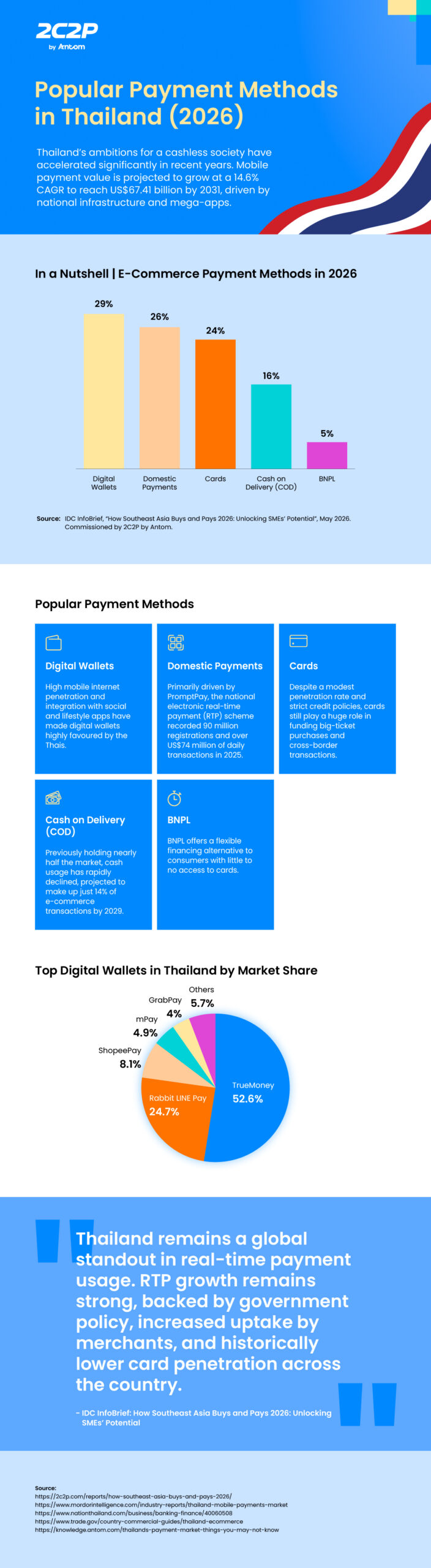
Previously recording 18.6 million users with a total transaction volume of US$1.05 billion in 2020, digital wallets have since massively expanded to 116.5 million users in 2023. According to the 2026 IDC InfoBrief commissioned by 2C2P, digital wallets now dominate Thailand’s e-commerce market in 2026, constituting an estimated 29% (US$6.67 billion) of total e-commerce transaction volume. This figure is expected to remain constant (US$9.57 billion) by 2029.
The popularity of digital wallets in Thailand is primarily attributed to high mobile internet penetration and advanced network infrastructure, along with the strategic integration of financial services into social and lifestyle apps commonly used by the tech-savvy Thai population.
Below is a breakdown of the most popular digital wallets in Thailand in 2023:
TrueMoney leads the digital wallet sector, supported by its wide acceptance across major retail chains and convenience stores like 7-Eleven. As for RABBIT Line Pay, its integration with the LINE messaging platform, a popular messaging platform used by Thais, makes it favoured as an alternative digital wallet option.
Businesses aiming to stay competitive in Thailand must ensure payment acceptance for the most dominant wallets. As illustrated in our partnership with Thailand Post, this is easily done with 2C2P, as we seamlessly expand businesses’ payment offerings with support for popular digital payment methods like digital wallets.
Coming up at a strong second are domestic payments, which the 2026 IDC InfoBrief sponsored by 2C2P notes constitute an estimated 26% (US$5.98 billion) of total e-commerce transactions in 2026. This figure is expected to grow steadily, reaching 29% (US$9.57 billion) and going neck-and-neck with digital wallets by 2029.
As earlier mentioned, Thailand’s national electronic RTP scheme PromptPay is the primary driver of digital payments in the kingdom. Registrations spiked by 14% to reach over 90 million in 2025, and daily transactions exceeded 74 million in the same year.
Developed under the government’s National e-Payment Master Plan, PromptPay has been deeply integrated into everyday consumer habits, having powered more than 24.3 billion transactions in 2024 alone.
To further enhance PromptPay’s capabilities, the Bank of Thailand forged several cross-border payment linkages with other domestic RTP schemes, including Singapore’s PayNow, Malaysia’s DuitNow, Indonesia’s QRIS, Japan’s StarPay, and more. Equipped with these payment interoperability capabilities, PromptPay now facilitates low-fee, no-frills, and almost-instant overseas transactions, in turn supporting e-commerce and tourism.
More recently in 2025, TAGTHAi collaborated with Kasikorn Bank (KBank) to roll out the TAGTHAi Easy Pay digital wallet to further deepen the accessibility of digital payments in Thailand. Standing as Thailand’s first digital wallet designed for foreign tourists, TAGTHAi Easy Pay enables international visitors to seamlessly make QR digital payments in Thailand without first converting their currency to Thai Baht.
Despite Thailand’s historically low card penetration rate, cards are tied with domestic payments as the second-most popular payment method for e-commerce in the kingdom. According to the 2026 IDC InfoBrief sponsored by 2C2P, card payments made up 24% (US$5.52 billion) of total e-commerce transactions in 2026. This figure is expected to remain steady, increasing slightly to 25% (US$8.25 billion) by 2029.
With cross-border transactions accounting for around 30% of Thailand’s e-commerce market, cards continue to play a pivotal role in the kingdom’s e-commerce landscape. This is especially true for high-value purchases and international retail, as credit cards provide crucial security features and consumer protections that other payment methods may not be able to guarantee.
Looking ahead, network tokenisation is set to transform the way Thai consumers pay with cards. Developments such as Click to Pay, the new checkout standard from EMVCo, equip consumers with a unique digital identifier that minimises the manual entry of sensitive card information when making payments.
Alternative payment methods like Cash on Delivery (COD) have historically been a staple in Thailand, as reflected in the latest IDC InfoBrief sponsored by 2C2P, where they constituted an estimated 16% (US$3.68 billion) of total e-commerce transactions in 2026. However, COD is experiencing a steady structural decline, projected to plummet to 12% (US$3.96 billion) of the total e-commerce transactions by 2029.
This comes as no surprise, especially given Thailand’s ardent pivot to a digital economy. Combined with improved logistics networks and increased trust in digital payments, consumer preferences have shifted in favour of digital payment methods.
While cash is still used for smaller purchases and among rural communities, it will no longer serve as a central driver of Thai e-commerce in the future.
Although BNPL comes in last, the latest IDC InfoBrief sponsored by 2C2P reveals that it still held an estimated 5% (US$1.15 billion) of total e-commerce transactions in 2026, set to remain constant at 5% (US$1.65 billion) by 2029. 34% of surveyed merchants in the same InfoBrief also noted the rise of BNPL in Thailand, as they appeal to demographics with limited access to credit and debit cards. Additionally, the youth tend to favour BNPL due to its flexibility and accessibility, enabling them to break up big-ticket purchases into smaller monthly payments.
In fact, the Thai BNPL market was forecast to reach US$3.94 billion in 2025, indicating that there is strong demand for the alternative credit solution as a viable means of payment in Thailand. By offering BNPL options directly at checkout, merchants can reduce cart abandonment and increase average order values.
Thailand has come a long way from its roots as a cash-heavy kingdom, with digital options like digital wallets and domestic payments completely overtaking cash for e-commerce purchases. PromptPay was, and still is, the key driver of Thailand’s digital payment transformation, with its ubiquitousness strongly indicating Thais’ ready acceptance of its viability.
Driven by strong governmental and central bank support, Thailand will continue to develop its digital payment capabilities. In this regard, developing its contactless payment acceptance capabilities will go a long way in further boosting the kingdom’s digital-first ambitions.
As seen in the 2025 edition of the IDC InfoBrief sponsored by 2C2P, SEA enterprise merchants identified contactless payments as a crucial tenet of their business continuity. This is a gap that Thailand will need to close, given that previous editions of the IDC InfoBrief sponsored by 2C2P estimated that just 55% of POS systems in the kingdom had near-field communications (NFC) capability.
Looking into the near future, agentic payments will begin to take root in Thailand, equipping Thais with the ability to deploy autonomous AI-powered agents to order and pay for their purchases on their behalf.
Learn more about the top payment methods around the world. Check out the other articles in our Popular Payment Methods series:
2C2P is a full-suite payments platform helping businesses securely accept payments across online, mobile and offline channels, as well as providing issuing, payout, remittance and digital goods services.
With over 250 payment options ranging from credit cards to mobile wallets and an alternative payments network of more than 400,000 physical locations, 2C2P is the preferred payments platform of tech giants, airlines, online marketplaces, retailers and other global enterprises.
Want to take your business further in Thailand? Our friendly team is ready to help – talk to us today.

 Login
Login