
Solutions
Securely accept, manage, and make payments through one point of integration


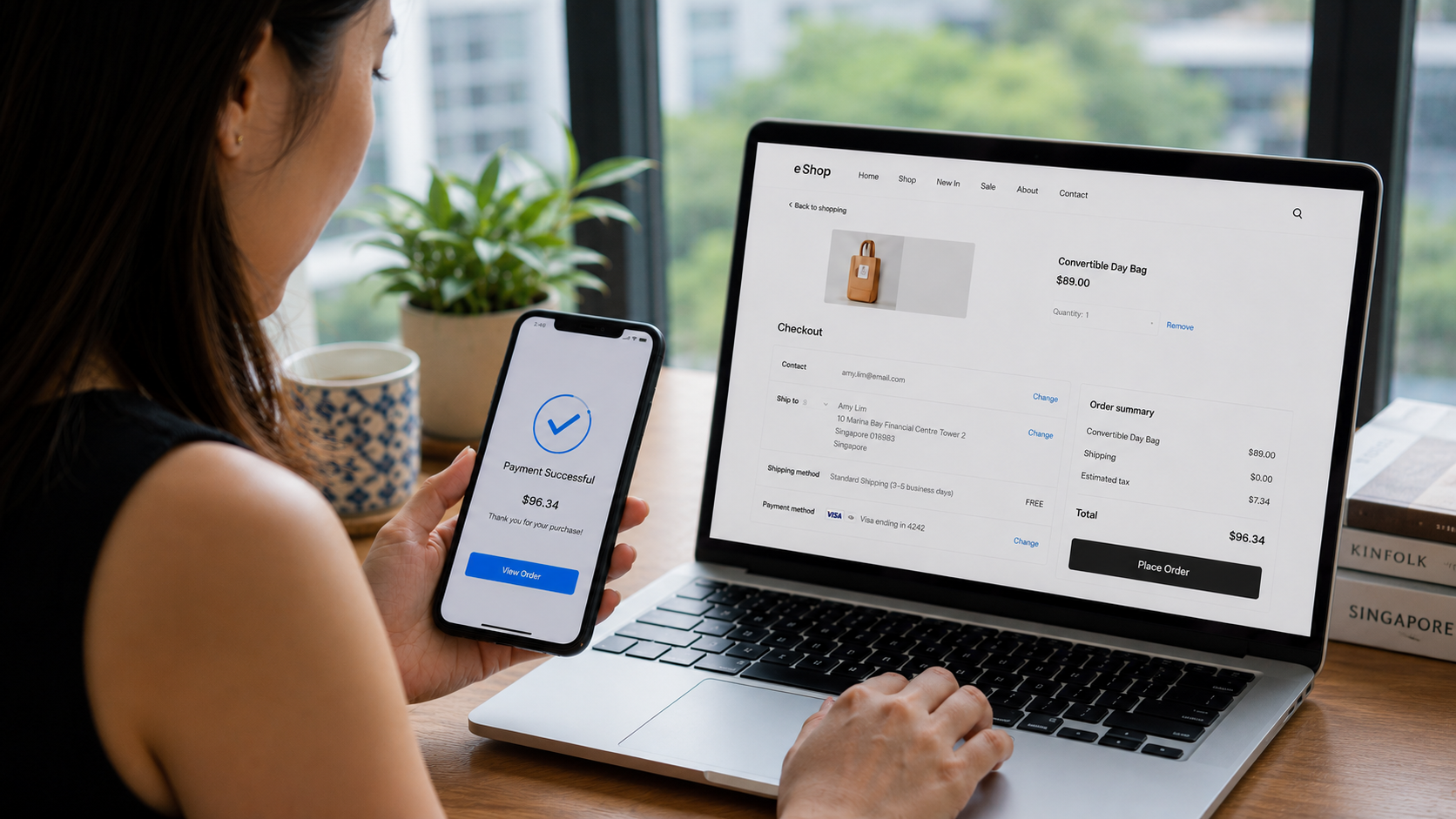
Your guide to choosing the best payment gateway for e-commerce: the checkout customers see, platform fit including Shopify, and how to manage fraud, settlement and growth in Southeast Asia.
A payment gateway is often overlooked as just another item that the tech and finance teams sign off. For an online store, though, their payment gateway for e-commerce is where browsing becomes a sale. The gateway sets which customers can pay, how many finish checkout, how much of each sale you keep, and even how quickly the money gets settled.
In that light, choosing a payment gateway for e-commerce is a decision that shapes revenue and drives growth. When it works well, customers barely notice it. When it works badly, you lose sales you have already spent money to win.
What sets an e-commerce payment gateway apart from others is that it has to serve two experiences at once. There is the customer’s experience at the checkout, where the lack of payment methods or false declines end a sale before it happens. And there is yours behind the checkout, where the gateway plugs into your systems, processes and protects each transaction, settles the money and keeps up as the business grows. The rest of this article follows those journeys, from the page a customer sees to the operations you run behind it.
The checkout is the most important page in your store, because it is the only one a customer reaches having already decided to buy, and the last place where they can still change their mind. A payment gateway designed for e-commerce shapes that page through the payment methods it offers, the effort it asks of the shopper to complete a transaction, and how much of the experience stays on your own site or is redirected elsewhere.
Depending on who your business serves, a customer in Singapore usually pays by card or PayNow, one in Malaysia by FPX online banking or through Touch ‘n Go e-wallet, one in the Philippines by GCash or over-the-counter cash, one in Thailand by PromptPay, and so on. A gateway that supports only a few local methods could potentially lose you customers in markets that you are trying to expand into.
A missing payment method may sound like a small gap, but it can be a significant opportunity cost if it turns out to be the one your customers prefer. Origin Mattress, which sells across Singapore and Malaysia, had been card-only in Malaysia. After adding e-wallets, online banking, FPX and instalments through a single integration, 2C2P’s setup processed around 70% of the company’s total transactions in Malaysia. The methods its customers preferred were simply the ones they had not been able to use before. 2C2P supports over 400 payment options across cards, digital wallets and alternative payment methods, plus more than 600,000 over-the-counter acceptance points across the region, ensuring ample coverage for popular payment methods in Southeast Asia.
Along with offering the right payment methods, you also need to consider customers’ payment flow. A hosted payment page is quick to deploy and keeps the heaviest security burden with the payment service provider, while an embedded checkout keeps the customer on your own pages for more control, and the right choice depends on how much of that experience you need to own. For returning customers, tokenisation allows a store to save card details securely, which removes friction for repeat buyers and is what makes subscriptions and one-click reorders work. Most of this now happens on a phone, too, so a checkout that is awkward on mobile is awkward for most of your shoppers.
What this means for merchants: List the markets you sell into now and the two or three you expect to enter next, then map each market’s leading payment methods against what a provider actually supports. Ask for online store payments coverage country by country, not a single global count. And walk through your own checkout on a phone, as both a first-time and a returning customer, counting the steps and checking for points of friction, since that is the experience most of your shoppers actually have.
Once you know the checkout you want, the next question is how the payment gateway connects to the store you already run, because that decides how quickly you can launch and how much engineering the change will cost.
Most online stores are built on a platform, and the cleanest integration is usually a ready-made plugin rather than custom code. 2C2P maintains plugins for the common online store builders, including Shopify, WooCommerce, Magento 2, PrestaShop and OpenCart. A payment gateway for Shopify shows how much this matters. With the Shopify plugin, the API work is handled between Shopify and 2C2P, so the merchant only sets 2C2P up from the Shopify admin, under Settings, then Payments, then additional payment methods, and customers are taken to a secure 2C2P-hosted page to pay. It is available on Shopify’s Basic plan and above.
If your store is custom-built, or you need full control of the checkout, the same payment gateway should still give you a direct route in. 2C2P, for example, offers three integration models. A hosted payment page is the fastest way to start accepting payments. A direct API lets you build and control the checkout yourself, and mobile SDKs let you accept payments natively inside an iOS or Android app.
What this means for merchants: Confirm there is a supported plugin for your exact platform and version before you shortlist, since a missing or outdated plugin turns a one-day setup into a development project. If you are on Shopify, WooCommerce or Magento, ask to see the plugin and its documentation. If you run a custom stack, ask which integration models are available and what each one asks of your team.
Online stores face a particular kind of fraud risk, because the shopper and their card are never physically in front of you. There is no chip to insert or PIN to enter, so nothing at the checkout proves the card really belongs to the person using it. When a sale turns out to be fraudulent, the cost falls on you as a chargeback, lost goods, and the staff time spent fighting the dispute.
Two things do most of the work. The first is authentication at the moment of payment, where EMV 3D Secure verifies the cardholder and can move liability for certain fraudulent transactions away from you. The second is the fraud screening running behind it, which should stop bad actors without blocking real customers. 2C2P’s fraud monitoring is built to do both, on top of the same PCI DSS and tokenisation foundations we cover in the Singapore payment gateway guide. GERALD.ph, a premium online grocery in the Philippines, moved to 2C2P after constant fraud investigations with a previous provider, and has reported no instances of fraud or stolen cards since.
What this means for merchants: Ask how a provider authenticates card-not-present payments, and how its fraud screening decides what to block. Aside from fraud incidence rates themselves, another thing to look into is how many genuine customers get declined, since every wrongly blocked order is a sale lost.
The best payment gateway that suits your store today still has to keep up as the business changes, and those changes tend to arrive in three forms:
2C2P covers these through features like multi-currency pricing, recurring billing, split payments and a single integration that works across Southeast Asia. It is why platforms like Lazada run a wide range of local methods through one connection rather than stitching together a provider per country.
What this means for merchants: Evaluate the payment gateway against your two-year plan. Ask whether adding a method or a market is a simple setting to switch on or a new development project; whether cross-border sales can be priced in local currency and settled in yours; and whether cases like subscriptions or payouts to separate suppliers are supported without extra work.
There is no single best payment gateway for every online store. The right solution should fit into your existing e-commerce platform, payment setup and operational framework, while offering the flexibility to adapt to your specific business requirements. This could mean supporting the payment methods your customers use, integrating with your existing systems, or configuring the payment experience around your checkout and settlement needs. As your business enters new markets or its requirements evolve, a gateway that can be customised and scaled with you can offer greater long-term value than one selected purely from a standard feature list.
Before you commit, it is worth asking any shortlisted provider a short set of questions in writing:
Start from your own data, look at where your customers are, how they already try to pay, where sales drop out of your checkout, and where the business is going next. The gateway that answers those questions is the one worth choosing.
2C2P is a full-suite payments platform helping businesses securely accept payments across online, mobile and offline channels, as well as providing issuing, payout, remittance and digital goods services. With over 400 payment options ranging from cards to digital wallets, and plugins for the platforms online stores already run on, 2C2P is the preferred payments platform of tech giants, online marketplaces, retailers and other global enterprises.
Want to take your online store further across the region? Our friendly team is ready to help. Talk to us today.
 Login
Login