

Solutions
Securely accept, manage, and make payments through one point of integration


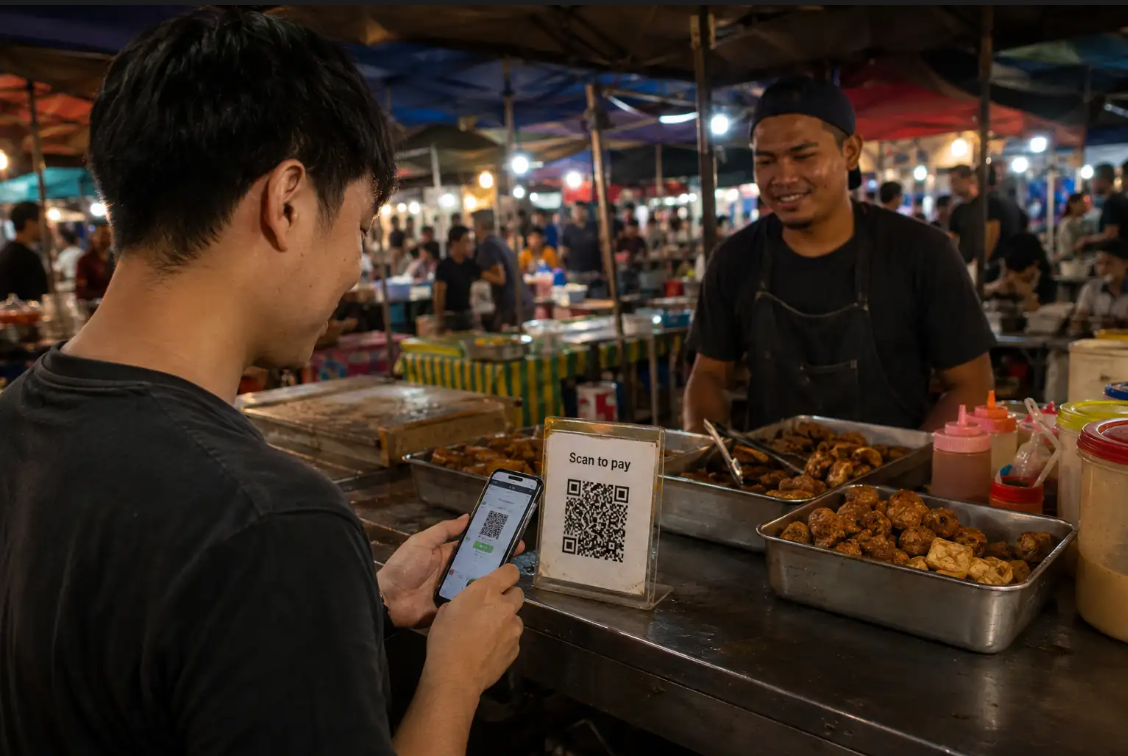
Choosing a payment gateway in Malaysia is a growth decision. It decides which payment methods your customers can use, how many payments go through, and how easily your business can expand across Southeast Asia.
In Malaysia, there is rarely just one way a customer wants to pay you.
Aside from standard payment methods such as cash and cards, a customer might put a large purchase on instalments, reach for DuitNow QR, pay from a Touch ‘n Go eWallet, transfer straight from their bank through Financial Process Exchange (FPX) or use the DuitNow Online Banking/Wallets (DOBW) platform. Every one of those is a route to completing a sale, and the payment gateway you choose decides how many of those routes are open to you.
That mix keeps shifting. Cards remain important, and real-time bank transfers, QR payments, e-wallets, and instalment options now account for a large share of online spend. Which one a customer picks depends on what they are buying and how much it costs.
That makes choosing a payment gateway in Malaysia a growth decision. The provider you choose determines who can pay you, how many payments go through, and how easily you can enter new markets when you are ready to sell in Singapore, Indonesia, the Philippines, Vietnam, or Thailand. Choose well, and you meet Malaysian customers the way they already prefer to pay, on a setup that travels with you across the region.
In this article, we explore six criteria that matter when selecting a payment gateway in Malaysia:
This is the criterion that moves revenue the most, and the one businesses often decide by assumption rather than data.
Compared with neighbouring Singapore, Malaysia’s payments landscape is considerably more fragmented. It is estimated that no single payment method in Malaysia accounts for more than 35% of e-commerce transaction value in 2026, compared to 73% for cards alone in Singapore, according to the 2026 IDC InfoBrief commissioned by 2C2P and Antom. Cards and domestic transfers each account for around a third of online payments, and digital wallets for a further 23%. Wallets are the fastest-growing share.
Bank Negara Malaysia (BNM) recorded 18.4 billion e-payment transactions in 2025, up 25% from the previous year, or 538 per person. DuitNow QR alone doubled to 3 billion transactions. Our guide to popular payment methods in Malaysia breaks down the full e-commerce transaction mix method by method.
DuitNow has become one of the country’s most important payment infrastructures. Through DuitNow QR, consumers can make payments using participating banking apps and e-wallets through a single interoperable QR standard. DuitNow’s rapid adoption means many consumers now expect real-time bank transfer options at checkout. The absence of widely used local payment methods can hurt conversion, particularly for merchants serving domestic consumers.
If you are choosing a payment gateway for ecommerce, online banking transfer is one method you cannot afford to leave out. FPX remains one of Malaysia’s most widely recognised online banking payment methods; just note that its mechanics are changing in 2026.
PayNet announced in 2025 that they are transitioning from FPX to DOBW, which does the same job but also lets customers pay from an e-wallet, not just a bank account. Banks are switching over one by one rather than all at once. Your customers will barely notice, since the bank login screen looks only slightly different. What matters is that your gateway supports both FPX and DOBW during the transition, so your checkout keeps working no matter which system a customer’s bank uses. Many established providers handle this behind the scenes, but it is a fair question to ask before you sign.
Bank transfers are only part of the picture, though. E-wallets and instalment options carry a big share of Malaysian e-commerce today. Touch ‘n Go eWallet, ShopeePay, Maybank MAE, GrabPay and Boost are the most widely used, and buy now, pay later (BNPL) providers such as Atome, Grab PayLater and SPayLater are increasingly common at checkout. If your gateway only covers cards and bank transfers, you are likely leaving sales on the table.
Start from your own transaction and decline data rather than market averages, and segment it by order value, customer type and whether the purchase is one-off or recurring. Those splits are usually where a payment method gap shows up.
Ask each provider to show coverage against that map rather than a headline method count, and to show payment success rates for the methods your business depends on. It is also worth asking what is on the roadmap for the next twelve months, since adding a payment method after go-live is rarely just a configuration change.
Regulatory requirements in Malaysia depend on the specific payment activities a provider carries out. For example, providers offering merchant acquiring services must register with Bank Negara Malaysia (BNM), while certain payment system operators and issuers of designated payment instruments require BNM approval. Businesses should therefore check the regulatory status and applicable requirements for the specific services their payment provider offers.
Depending on the services provided, the regulatory framework may involve the Financial Services Act 2013 (FSA), Islamic Financial Services Act 2013 (IFSA), and other payment system regulations.
Two recent developments are worth noting. BNM issued its Technology Requirements for Payment Services Regulated Entities on 12 March 2026, setting minimum standards for technology risk and system resilience, with full compliance due by 12 March 2027. It covers approved e-money issuers, registered merchant acquirers, licensed money services businesses and designated payment system operators, so it is fair to ask a provider how they are tracking against it. Approved operators of payment systems sit outside its scope, so it may not apply to every gateway you shortlist.
Separately, the Consumer Credit Act 2025 brought buy now, pay later providers under Consumer Credit Commission licensing, from 1 June 2026 with a six-month grace period. Any BNPL provider you use should be licensed, or able to show where it sits in the application process, before that period ends in December 2026.
Before entering commercial discussions, merchants should:
It is advisable to understand whether your payment gateway acquires transactions directly or through acquiring partners, and how it sits within BNM’s Policy Document on Merchant Acquiring Services, as this can affect settlement processes and accountability when issues arise.
Licence verification takes minutes and confirms which regulated activities a provider is authorised to provide. Commercially, scope matters, so check the provider’s licensed services against your expansion plan rather than your current operation. It is worth asking upfront how they would support you once you sell into other markets like Singapore or Thailand. Providers structure this differently, and the arrangement can shape the relationships and settlement you manage later, so it is better understood before you sign.
Security requirements can change, so ask the payment gateway providers on your shortlist for current documentation, not just assurances.
The baseline is PCI DSS, and the current active standard is v4.0.1. Version 4.0 was retired on 31 December 2024. Ask which version a provider is certified against, at what level, and by which qualified assessor. A Level 1 Service Provider assessment is the most rigorous tier. Beyond PCI DSS, request PCI 3DS, ISO/IEC 27001, ISO/IEC 27701, SOC 2 Type 2 and CSA STAR. 2C2P holds all of these, and the certificates can be accessed from our security page.
Malaysia’s Personal Data Protection Act 2010 also applies to how a provider handles your customers’ data, and the Personal Data Protection (Amendment) Act 2024 brought in mandatory breach notification and a requirement to appoint a data protection officer, in force in stages from January 2025. Ask a provider how it meets both.
Then there is authentication. EMV 3D Secure can strengthen cardholder authentication and may affect liability treatment under applicable card-scheme rules. The mechanism that matters commercially is risk-based authentication, which allows low-risk transactions to proceed through a frictionless flow and challenges only transactions that warrant it.
Tokenisation is the other key topic to consider. Replacing card details with tokens reduces the exposure and usefulness of compromised card data, and network tokenisation keeps stored credentials current when a card is reissued, which protects subscription and repeat-purchase revenue.
Security credentials are not only a risk question. They are a cost and conversion question. The integration model you choose determines how much of your own environment falls into PCI scope, which drives your audit burden every year thereafter.
Authentication settings determine how many genuine customers get challenged, and therefore how many face greater friction at checkout. Ask what proportion of transactions pass through the frictionless flow, how tokens are maintained when cards are reissued, and which party carries liability under each authentication outcome. Clarify any answer that cannot be supported with current documentation.
When evaluating payment service providers, many businesses naturally focus on the Merchant Discount Rate (MDR) because it is the easiest figure to compare. But while pricing is important, it is only one part of the equation. A provider’s ability to help genuine customer payments go through successfully can have an even greater impact on your revenue.
Say your business processes RM10 million in card payments. Reducing the MDR by 0.10% saves around RM10,000. At the same time, if more genuine customer payments are approved instead of being mistakenly declined, the sales generated can match, or even outweigh, those savings. Approval outcomes depend on many factors beyond any single provider’s control, but a capable provider should give you the tools to pursue competitive pricing and strong payment performance together.
In addition to the pricing proposal, ask how the provider helps maximise successful payments while keeping fraud under control. Many reputable providers offer features such as secure customer authentication, intelligent fraud screening and continuous transaction monitoring. These work in the background to protect your business while making it as easy as possible for genuine customers to complete their purchases.
Some providers also offer more advanced fraud management solutions. For example, through 2C2P, merchants can use Cybersource Decision Manager, a Visa solution, which analyses transactions in real time to identify suspicious activity while helping genuine customers complete their payments with minimal disruption.
Good fraud management isn’t about blocking more transactions; it’s about making better decisions that stop fraudulent payments while leaving genuine customers undisturbed. Done well, that reduces both fraud losses and the sales lost to incorrectly declined transactions.
When evaluating payment providers, don’t base your decision on fees alone. Consider the overall value they bring to your business.
Ask questions such as:
In practice, the real cost of accepting payments isn’t just what you pay in fees; it is also the sales you could lose when genuine customers can’t complete their purchases.
This criterion determines how much work your team carries, at launch and every month after. The choice between a hosted payment page and a direct API integration is a genuine trade-off. A simple redirect to a hosted payment page can launch faster and shifts much of the compliance burden to your payment service provider, though at the cost of some control over the page’s look and feel. Meanwhile, a direct integration keeps the customer on your site and gives you full control of the checkout, but places more of the security scope and technical burden on you. Our guide to optimising the online checkout process covers this in more detail. The right path depends on your engineering capacity and how much of the experience you need to own.
Integration support is a criterion in its own right, as it can impact your customers’ checkout experience. Solaroo, a Malaysian solar provider and part of Pekat Group, previously collected payments manually and matched invoices to customers by hand. Deposits now run through payment links, progressive payments run through the Solaroo mobile app, and both feed the same finance system, so cards, FPX and instalment plans reconcile without anyone chasing them.
“We use 2C2P for our payment collections, especially for our B2C segment. Customers pay a deposit via the EasyPay link and then make progressive payments in our mobile app, Solaroo, which is linked to 2C2P and our finance software. This ensures accuracy, accountability, and easier management for our various teams.”
Johann Sze, Director, Solaroo Systems
Before anything goes live, a provider assesses your business and sets up your account, and that timeline can determine whether you hit a target launch date. Ask early for the expected onboarding and risk review timeline, since it shapes everything that follows.
Operational questions that often surface later include:
Shortlist based on reach and security, then decide based on operational capabilities, because operations is where the relationship actually lives. Before you commit, get clear answers to a few questions:
The quality of the provider’s operational support will matter long after integration is complete.
Many companies that select a payment gateway in Malaysia eventually expand into neighbouring Southeast Asian markets, making regional capability an important consideration from day one.
Payment behaviour varies significantly across Southeast Asia. Malaysia relies heavily on DuitNow, FPX and digital wallets such as Touch ‘n Go eWallet and GrabPay, while Thailand runs on PromptPay and mobile wallets, Indonesia on QRIS and bank transfers, and Vietnam on wallets and VietQR bank transfers, with cash-on-delivery in steep decline, according to the 2026 IDC InfoBrief commissioned by 2C2P and Antom. A payment gateway that performs well in Malaysia but lacks regional depth may require separate integrations and operational processes as your business grows.
Currency is its own expansion cost. Selling across the region means settling in several currencies and absorbing foreign-exchange spreads, and pricing in a currency customers do not recognise can hold back conversion. Settling in the currencies you need, with multi-currency pricing that lets customers pay in their own currency, helps you manage foreign exchange costs. 2C2P’s multi-currency pricing (MCP) is built for this. When handled well, it lowers expansion costs and gives customers a smoother checkout.
This is the difference between one provider and several. JA Assure, the insurtech that puts medical malpractice cover for healthcare professionals online, sells across Malaysia, Singapore and Hong Kong. Malaysian customers get cards, FPX, digital wallets, and instalment plans; Singapore customers get the mix the market expects: the same platform, different local methods, and no separate integration per country.
“Partnering with 2C2P has allowed us to grow our business knowing that payments will be taken care of in a fast, secure and reliable manner in a fast-growing, agile environment.”
Vijay Anand, Head of Technology, JA Assure
Evaluate the gateway against your two-year map, not your current market. Assess which local methods it supports in each country you intend to enter; whether they run through the same integration and contract; and what settlement looks like across currencies, including whether the provider can convert currencies so you are not opening a separate account per market.
Also, clarify what entering a new market requires from your team: does it mean fresh onboarding, a separate reconciliation process, or simply enabling additional methods on an existing setup?
Before you sign, ask for the following in writing.
Cross-border reach widens your customer base without you doing anything. DuitNow QR already connects to Thailand’s PromptPay, Singapore’s NETS QR, Indonesia’s QRIS, and Cambodia’s KHQR, and bank transfers run on a separate rail through the link with Singapore’s PayNow. Cross-border QR transactions grew 2.5 times to 29.7 million in 2025, so customers are clearly using this infrastructure. PayNet and NPCI International agreed a phased linkage with India’s UPI in February 2026, beginning with Indian travellers paying at Malaysian merchants, and Malaysia is a founding member of Nexus Global Payments, set up by six central banks in 2025 to connect their instant payment systems. PayNet has said it is targeting a Malaysia-to-Singapore pilot towards the end of 2027. None of it reaches your checkout unless your provider enables it.
Open finance should be watched closely. Bank Negara Malaysia’s exposure draft, issued in November 2025, proposes that banks share customer data through standardised APIs wherever the customer consents, starting with the largest banks in January 2027 and smaller institutions in 2028 and 2029. The framework is not final, so treat the move and those dates as proposed. It points to a market where more of your payment and settlement data moves with you rather than sitting inside whoever you signed with, and PayNet is already piloting it with seven banks and the Employees Provident Fund through the second half of 2026. Worth understanding before you choose a provider, not after.
Agentic ecommerce payments sit further out, but the direction is becoming clearer. If AI assistants begin completing more purchases on a customer’s behalf, checkouts may need to authenticate an agent as well as a person. It is early, but it is worth asking any provider you shortlist how they are thinking about it.
If you are looking for the best payment gateway in Malaysia, the honest answer is that there is no single name to recommend: it depends on your payment method mix, licensing needs, and regional plans. It has the capabilities to keep up with your ambitions.
2C2P is a full-suite payments platform helping businesses securely accept payments across online, mobile and offline channels, as well as providing issuing, payout, remittance and digital goods services. With over 400 payment options, from credit cards to mobile wallets, 2C2P is the preferred payments platform for tech giants, airlines, online marketplaces, retailers, and other global enterprises.
Want to take your business further in Malaysia and across the region? Our friendly team is ready to help, so talk to us today.

 Login