

Solutions
Securely accept, manage, and make payments through one point of integration


Home to 36.3 million people, Malaysia boasts the third-largest economy in Southeast Asia, with a GDP of US$421.97 billion in 2024. Digital payments are favoured in internet-savvy Malaysia, where the internet penetration rate stands at 97.7%.
Malaysia has made great strides toward its ambition of becoming a digital-driven, high-income economy by 2030, having recently upgraded this goal to become an AI Nation in July 2025.
Specific to digital payments, 2C2P’s IDC InfoBrief 2026 highlights that Malaysia’s e-commerce volume reached a new high of US$16.1 billion in 2024, of which 94% was transacted through digital payment methods.
Malaysia’s ready acceptance of digital payments comes as no surprise. The government’s MYDIGITAL initiatives to drive Malaysia’s digitalisation, combined with the central bank, Bank Negara Malaysia’s (BNM) cashless e-Duit programmes, and the widespread adoption of DuitNow QR by merchants, position the country as a strong proponent of digital payments.
In fact, BNM’s Annual Report 2025 points out that Malaysia’s e-payment transactions rose by a compound annual growth rate (CAGR) of 17% between 2022 and 2025, consistently tracking ahead of the Financial Sector Blueprint 2022-2026 targets of 15% CAGR.
In this article, we explore Malaysia’s most popular payment methods, including:
Topping Malaysia’s list of preferred payment methods are real-time account-to-account domestic payments, with key methods such as DuitNow and Financial Process Exchange (FPX) forming a crucial pillar of Malaysia’s digital payment infrastructure.
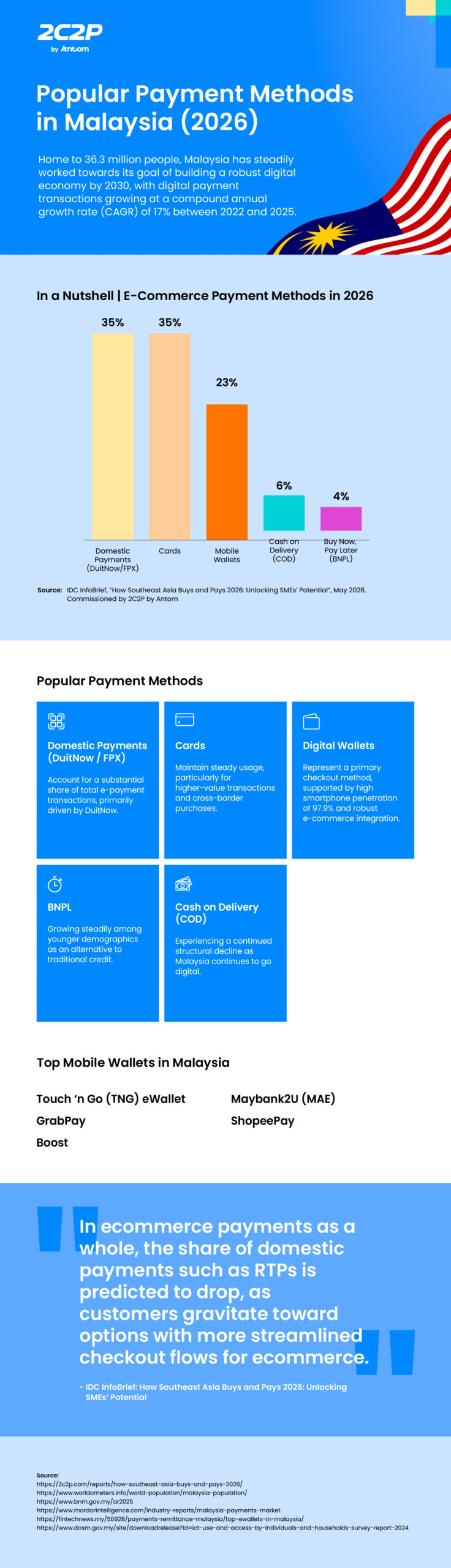
According to 2C2P’s IDC InfoBrief 2026, domestic payments constitute an estimated 35% (US$6.65 billion) of total e-commerce transactions in 2026. Although they will experience a slight drop by 2029, they will still account for a substantial 34% (US$8.84 billion) of total e-commerce transactions.
In particular, DuitNow QR has experienced explosive growth, with merchant registrations jumping 47% year-on-year to reach 2.6 million in 2025. This has gone a long way in driving the spike in DuitNow QR transactions, which reached a whopping 3 billion in the same year.
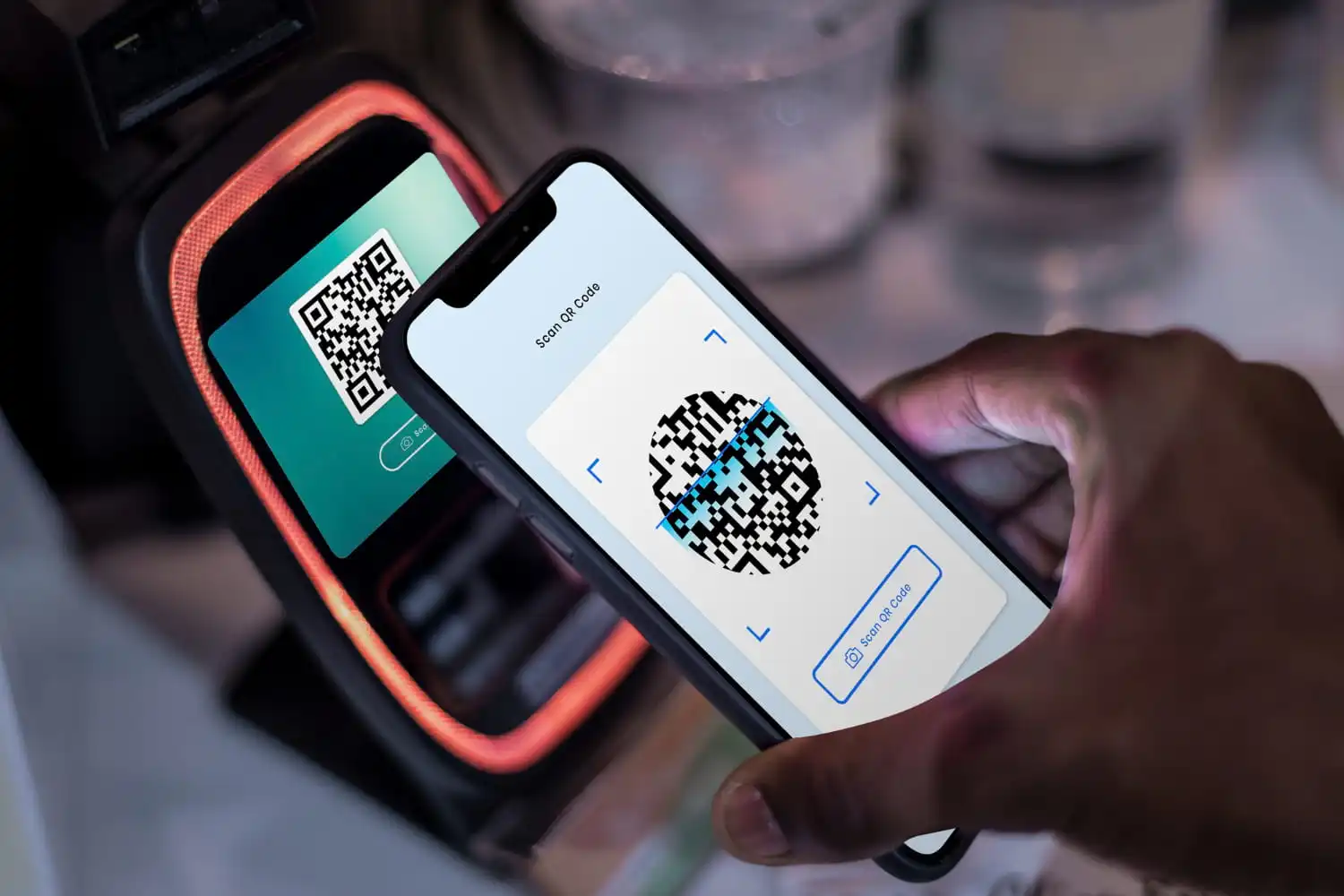
Facilitated by Bank Negara Malaysia’s Payments Network Sdn Bhd (PayNet), Malaysia’s national payment network, DuitNow QR helps consolidate a fragmented payments landscape, enabling consumers to scan a single QR code to pay instantly through any participating bank or even digital wallet.
In the last few years, DuitNow has also established linkages with other Southeast Asian countries’ real-time payment (RTP) systems, including Singapore’s PayNow and Thailand’s PromptPay. This marks a significant milestone for DuitNow, as it evolves from a purely local RTP system to a facilitator of seamless cross-border payments across Southeast Asia.
Alongside DuitNow, FPX continues to operate in parallel as a direct and secure means for Malaysians to pay via online banking. Implicitly trusted by the banked Malaysian population, FPX has long served consumers paying online with their bank accounts.
With partnerships inked with most of Malaysia’s banks, FPX is also beneficial for merchants as it provides instant liquidity and is cost-efficient, bypassing international card network fees that can potentially eat into their profit margins.
Cards continue to maintain strong relevance in Malaysia, tying with domestic payments at 35% (US$6.65 billion) of total e-commerce transactions in 2026, according to 2C2P’s IDC InfoBrief 2026. Interestingly, cards are expected to overtake domestic payments and rise to 37% (US$9.62 billion) of total e-commerce transactions by 2029.
BNM’s Annual Report 2025 further highlights the growth split between debit and credit cards, with debit card transaction volumes increasing by 20.5% and credit card transaction volumes by 10.9%. Contactless card payments further experienced a high growth of 20.3%, reaching 2 billion transactions in 2025.
The sustained growth of card payments is attributed to the combined efforts of Bank Negara Malaysia (BNM) and the government’s push to develop Malaysia’s digital economy. Initiatives such as expanding contactless terminal infrastructure and enforcing stronger card security standards actively reinforce consumer trust, while revised interchange fee frameworks make card acceptance more affordable for businesses.
As cards are already a familiar digital payment option, they directly benefit from the official digitalisation push, remaining the preferred choice for big-ticket purchases, subscription services, and international e-commerce.
To fully capture this card-driven revenue, merchants must integrate payment solutions that deliver high authorisation and transaction success rates with minimal friction. Seamless checkout standards like Click to Pay have begun to take root for this exact reason, leveraging secure, network-tokenised credentials to authenticate users without manual data entry. In turn, Click to Pay helps Malaysian merchants reduce cart abandonment and ensure a higher rate of completed, successful transactions.,
With a smartphone penetration rate of 97.9% in 2024, Malaysia has readily embraced digital wallets. According to 2C2P’s IDC InfoBrief 2026, digital wallets make up an estimated 23% (US$4.37 billion) of total e-commerce transactions in 2026, projected to rise to 25% (US$6.5 billion) by 2029.
Used primarily for day-to-day transactions, digital wallets are especially preferred by younger generations of Malaysians, with the 25 to 34 age group recording the highest usage at 65% in 2025. The 18 to 24 age group comes in at a close second, at 62%.
Given the burgeoning demand, Malaysia’s digital wallet market is fiercely competitive and highly saturated. Below are the top digital wallets used in Malaysia, according to Fintech Malaysia:
Of these digital wallets, Touch ‘n Go (TNG) stands out for having evolved from a highway toll payment system to an expansive, all-in-one superapp. Typically used for lifestyle and essential activities, the app’s digital wallet feature provides Malaysian consumers with a frictionless, one-tap experience for settling retail and bill payments.
TNG aside, digital wallet platforms generally offer aggressive loyalty programmes and gamified rewards to increase user stickiness. To further retain user loyalty, digital wallets in Malaysia have increasingly rolled out embedded finance features like micro-insurance and digital investments. This is done to encourage consumers to default to wallets to fulfil all their e-commerce needs repeatedly.
Cash on Delivery (COD) has been on a steady decline in Malaysia, contributing an estimated 6% (US$960 million) of total e-commerce transactions in 2024, according to 2C2P’s IDC InfoBrief 2026. This is expected to dwindle to 5% (US$1.3 billion) by 2029.
As covered by this article so far, the decline of cash can be attributed to a variety of factors, including the governmental push to digitalise Malaysia’s economy, improved digital payment security, and the widespread accessibility of the DuitNow RTP network.
Today, COD is largely used by the rural population and some small & medium enterprises (SMEs). According to 2C2P’s IDC InfoBrief 2026, 14% of surveyed SMEs continue to use cash heavily in Malaysia, citing high transaction fees, integration complexity, and difficulty with understanding regulatory requirements as major barriers to digital payment adoption.
Despite this, it must be noted that Malaysia ranks last in Southeast Asia for SMEs reporting high cash usage, aligning with the country’s overall ambition to fully digitalise payments by 2030.
Buy Now, Pay Later (BNPL) has gained significant traction in Malaysia, making up an estimated 4% (US$760 million) of total e-commerce transactions in 2026, according to 2C2P’s IDC InfoBrief 2026. This number will increase slightly to 5% (US$1.3 billion) by 2029, overtaking cash-on-delivery and other legacy payment methods.
BNPL is particularly favoured by Gen Z and Millennial consumers. BNPL allows them to break up purchases into at least three zero-interest payments, while offering lower barriers to entry compared to traditional credit card instalment plans.
Based on a 2025 report by the Consumer Credit Oversight Board Task Force (CCOB), Malaysia recorded at least 6.5 million active BNPL account holders in H1 2025. Although Malaysia has 16 BNPL primary providers, more than 90% of the country’s users are concentrated in the following platforms:
The average BNPL transaction size is below RM100 (US$24.85), indicating that BNPL is primarily used for everyday purchases such as F&B, retail, transport, and services.
Malaysia’s path forward is clear. Backed by both the government and central bank, the country’s goal to evolve into a digital economy is steadily being realised, with the payments landscape defined by strong consumer preference for digital payment options like DuitNow and digital wallets.
Looking ahead, we can expect to see Malaysia simplifying payment operations and streamlining checkout experiences further with technologies like Software Point-of-Sale (softPOS). SoftPOS transforms any compatible device into a payment terminal, eliminating the need to commission expensive and bulky payment terminals to accept payments.
Concurrently, agentic AI also offers the possibility of having automated bots participate in payment operations. In fact, Mastercard Malaysia recently piloted its first agentic transaction with CIMB and RHB, where they completed a live ride-booking transaction with mobility platform hoppa.
With such exciting technical advancements on the horizon, discerning businesses should partner with an established payment gateway like 2C2P. As the Southeast Asia arm of Antom, we pride ourselves on providing the technology and expertise required to implement modern payment solutions securely and efficiently.
Learn more about how 2C2P supports the latest developments in the payments space: How Southeast Asia Buys and Pays 2026
Learn more about the top payment methods around the world. Check out the other articles in our Popular Payment Methods series:


 Login
Login