

Solutions
Securely accept, manage, and make payments through one point of integration



Cross border payments are becoming essential for Southeast Asian merchants expanding internationally. This article explores how businesses can manage multi-currency payments, settlement, reconciliation, local payment preferences and fraud through a more unified payment setup.
Selling across borders is now a realistic growth path for merchants in Singapore and Southeast Asia. Whether you ship products internationally, serve overseas travellers, or run a digital platform, the ability to accept payments from customers around the world is no longer optional.
Accepting an international card or wallet is only the first step. Merchants still need to manage currency conversion, settlement timing, reconciliation, local payment preferences and fraud risk. This is where a solid cross border payments setup matters.
This article explains what SEA merchants actually need from an international payment gateway, the operational issues that appear once international volume grows, and how to keep the whole process manageable.
Cross border payments are transactions where the customer and the merchant are located in different countries. Typical examples include an Australian shopper buying from a Singapore online store, a Thai visitor booking a hotel in Singapore, or a Malaysian subscriber paying a company based in Indonesia.
Each of these payments crosses national borders and therefore involves different currencies, banking systems, payment networks and regulatory requirements. The merchant’s objective is straightforward: make the checkout feel familiar and trustworthy for the customer, while ensuring funds arrive predictably and can be reconciled without excessive manual work.
For many SEA businesses the first international sales arrive through global cards. As volume increases, the limitations of a pure card setup become visible and merchants begin looking for broader coverage and better multi-currency control.
From the customer’s perspective the flow looks simple. They select a payment method, complete authentication if required, and receive confirmation. Behind the scenes several steps take place:
The parts that most affect merchants are the points where cost, delay or complexity appear:
A capable cross border payment gateway reduces these frictions by handling routing, conversion options and consolidated reporting in one place rather than forcing the merchant to manage several disconnected systems.
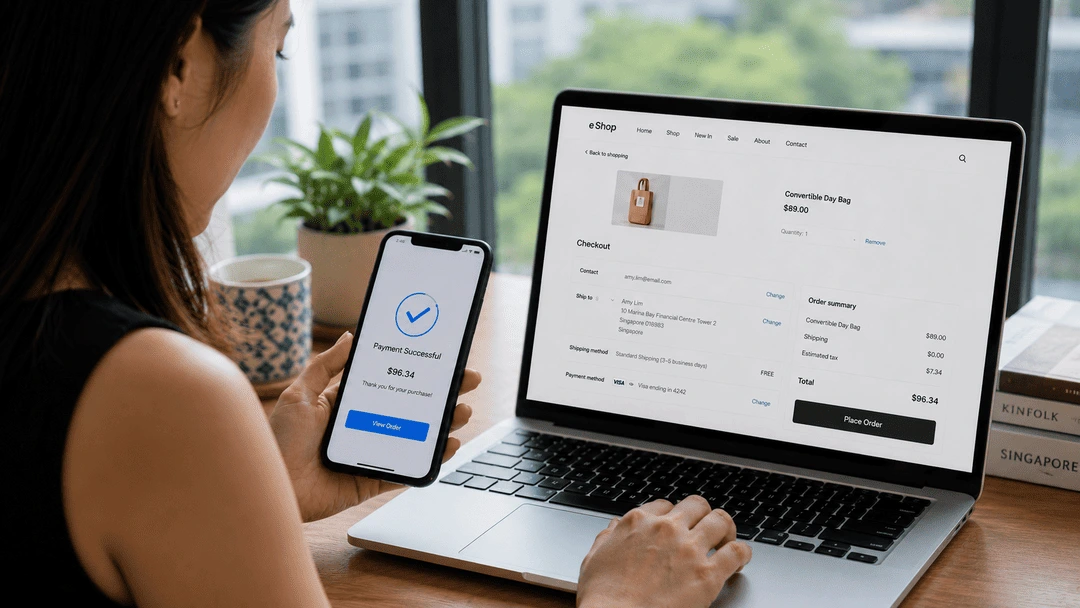
Alt text: Asian merchant reviewing international orders and settlement data to manage cross border payments across multiple markets.
Southeast Asia is not a single payment market. Preferred methods, banking behaviour and regulatory environments differ significantly by country:
A payment approach that works well in Singapore frequently underperforms when the same merchant enters Indonesia or Thailand. Merchants expanding regionally therefore need an international payment gateway that can reach both global card schemes and the local methods that actually convert in each market, without requiring a separate technical integration for every country.
At the same time, regional central banks have been connecting their instant payment systems. Singapore has live real-time linkages with Thailand, Malaysia, Indonesia and India. Details of these linkages are published by the Monetary Authority of Singapore. These connections improve speed and cost for certain corridors, but the majority of international e-commerce and travel payments still flow through commercial card and wallet rails. Merchants therefore still need a commercial cross border payment gateway that covers both the traditional and the newer rails.
When a customer pays in one currency and the merchant settles in another, several questions arise. Which rate is applied? When is the conversion locked? Who bears the FX risk? How clearly can the finance team see the final net amount? Without a proper multi currency payment gateway, these answers are often scattered across different reports or only become clear days after the transaction.
There is also a customer-experience dimension. If the customer’s card is charged in a foreign currency with an unexpected conversion, the charge may look unfamiliar on their statement. This can trigger chargebacks or simply reduce the likelihood of a repeat purchase. Offering local-currency pricing where it makes commercial sense is one practical way to reduce that friction.
Customers abandon checkouts when the available payment methods feel unfamiliar or when an unexpected currency conversion appears. In markets where local wallets or bank transfers dominate everyday spending, offering only international cards usually leaves conversion on the table. The reverse is also true: a Singapore-based merchant selling to Australian or European customers still needs reliable card acceptance.
The practical requirement is therefore dual coverage: global methods for international customers and strong local methods for regional customers, delivered through a single operational setup.
As international volume grows, finance teams face multiple settlement files, different cut-off times, varying currencies, refunds and chargebacks. When each market or method is handled by a different provider, reconciliation becomes a recurring monthly project rather than a routine process. The hidden cost is not only staff time; it is also delayed visibility into which corridors and methods are actually profitable.
Cross border transactions generally carry higher fraud risk than domestic ones. Issuers and schemes apply different rules, and attack patterns often target international merchants. The payment provider’s fraud tools, 3-D Secure handling, and ability to tune rules for cross border traffic therefore matter more than they do for purely local sales. Excessively aggressive filtering, however, can also increase false declines and hurt legitimate conversion.
When evaluating a cross border payment gateway, the following practical criteria tend to matter most for SEA merchants:
The ability to accept both international cards and key local methods across several Southeast Asian markets through one technical connection. Separate gateways for each country create ongoing maintenance and reconciliation cost.
A genuine multi currency payment gateway lets merchants accept payments in different currencies, display local prices where useful, and settle in one or more currencies with clear reporting. This is different from simply letting the customer’s card network perform a conversion that the merchant cannot control or easily audit.
Predictable settlement timelines and a single view of transactions across markets and methods. Finance teams should be able to match payouts to orders without stitching together files from multiple providers.
Coverage of the wallets and account-to-account schemes that actually drive conversion in each target market, not only the major global card brands. In several SEA countries local methods account for a large share of successful online payments.
Appropriate risk controls that reduce fraud without generating excessive false declines on legitimate international customers.
Traditional cross border payments remain slower and more expensive than domestic payments in many corridors. Initiatives such as the BIS Project Nexus (an international central-bank project, not a commercial provider) aim to connect regional instant payment systems and improve speed and transparency. Merchants still need a commercial provider that can operate across both the existing card and wallet landscape and these evolving rails.
Most merchants do not need to solve every market on day one. A practical approach usually looks like this:
Some merchants start with international cards only and add local methods once they see volume from specific countries. Others launch with strong local coverage in a new market and keep global cards as a secondary option. Both paths can work. The expensive path is the one that creates a patchwork of separate gateways that later become difficult to reconcile and maintain.
A unified platform that combines global card acceptance, regional local methods and multi-currency settlement usually scales more cleanly and gives finance teams a single source of truth.
Cross border payments are now a core capability for many Southeast Asian merchants that want to grow beyond their home market. The difference between a painful and a manageable setup usually comes down to three factors: the range of payment methods you can accept, how cleanly you can handle multiple currencies, and how much operational work settlement and reconciliation create as volume increases.
Choosing the right international payment gateway early reduces friction for customers, improves visibility for finance, and leaves room to add new markets without rebuilding the payments stack each time.
2C2P helps merchants accept payments across Southeast Asia and beyond through a single platform. The coverage includes global card schemes, local payment methods and multi-currency capabilities, so merchants can support both international and regional customers without managing multiple integrations.
Whether you are entering one new market or scaling across several countries, the infrastructure is designed to keep the customer experience smooth and the back-office manageable.
Schedule a chat with us today.
 Login
Login