

Solutions
Securely accept, manage, and make payments through one point of integration




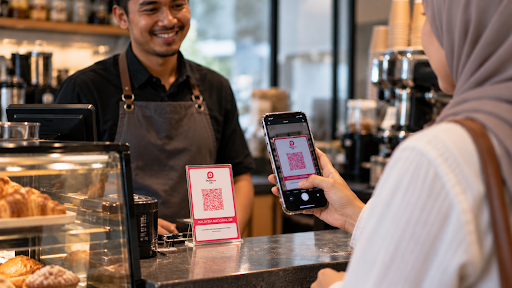
DuitNow QR is Malaysia’s national QR payment standard, enabling merchants to accept payments from participating banks and e-wallets through a single QR code. This guide explains how businesses can accept DuitNow QR payments in-store and online, covering static and dynamic QR codes.
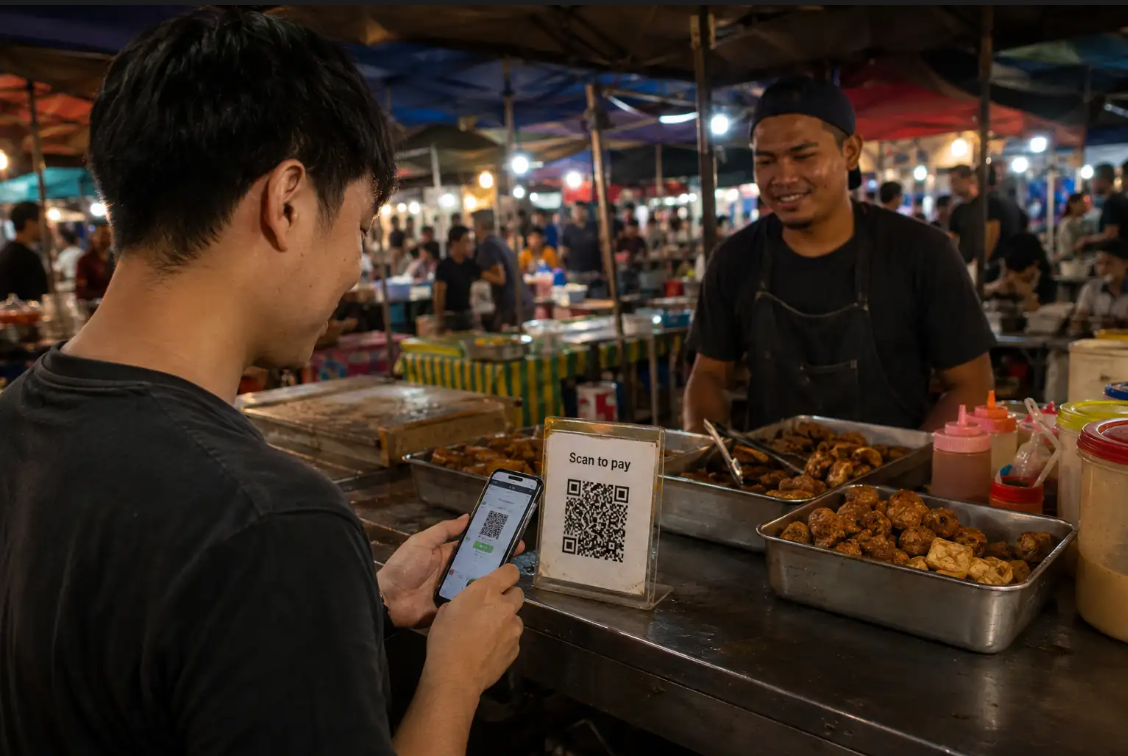
Scanning a QR code has become one of the most familiar ways to pay in Malaysia, at a hawker stall, a pharmacy counter or an online checkout. The 2025 Annual Report from Bank Negara Malaysia (BNM) records that DuitNow QR transaction volume doubled to three billion in 2025, with almost three million registered DuitNow QR touchpoints nationwide.
For businesses operating in Malaysia, understanding the role of QR payment in Malaysia is increasingly important. Domestic payments, which include DuitNow and FPX, make up an estimated 35% of Malaysian e-commerce transaction value in 2026, as noted in the 2026 IDC InfoBrief commissioned by 2C2P.
This guide explains how DuitNow QR works in-store and online, how to set it up, what to expect on fees and settlement, and how cross-border QR lets you accept payments from overseas visitors.
DuitNow QR is Malaysia’s national QR payment standard, operated by Payments Network Malaysia (PayNet). It launched in 2019, according to BNM’s Annual Report 2023.
What makes it particularly useful for merchants is its interoperability. A single QR code accepts payments from any participating bank or e-wallet app. For example, even if your merchant account is with a bank, a customer can still pay using Touch ‘n Go e-wallet by scanning the same code. The payment is then routed to your account without requiring a separate QR code or counter sticker for each payment app your customers use.
For the customer, the payment comes straight from their bank account or e-wallet balance, and BNM has confirmed that individual customers pay no additional charge for paying by DuitNow QR.
PayNet’s DuitNow QR documentation describes a few ways a QR payment can work, and each suits a different kind of business:
Dynamic QR reduces the chance of a customer keying in the wrong amount and allows each payment to match a specific order. That makes it the format most relevant to online checkouts and busier stores.
In-store, the customer opens their banking or e-wallet app, scans your static or dynamic code, and approves the payment. Your staff confirm the payment on a terminal, in an app, or via a payment notification before handing over the goods.
Online, a dynamic QR code is generated at checkout, and the customer scans it with their phone to pay. This works well when a customer is shopping on a laptop or desktop. On a mobile phone, scanning a code shown on the same screen is less practical, so it is worth offering an option that opens the customer’s banking or e-wallet app directly, such as FPX, alongside the QR code.
Whichever channel you use, confirm each payment through your provider’s payment notification or status check rather than relying on what the customer shows you on their screen.
PayNet’s DuitNow QR business page directs businesses to their preferred bank or acquirer to get started. There are two routes to accept DuitNow payments:
As a DuitNow QR merchant selling online, the gateway route lets your system request a dynamic QR code for each order and automatically receive the payment result. 2C2P’s payment channel reference lists DuitNow QR as a QR payment channel for Malaysia, and 2C2P is quick to set up and configurable around how you already work, so it can sit alongside the payment methods you already offer.
Businesses pay a Merchant Discount Rate (MDR) on DuitNow QR payments, a percentage of the transaction value that covers the cost of processing. A temporary fee waiver ran from 2019 until 1 October 2023. Since then, BNM has said that major banks and selected non-bank providers, which serve 75% of businesses accepting DuitNow QR, will continue to waive the fee for micro and small businesses. For other businesses, BNM says fees remain as low as, or lower than, debit card payment fees.
BNM’s Annual Report 2023 describes this as a tiered model, with larger merchants paying MDR and smaller merchants receiving a preferential rate. Your own rate depends on your provider and your business, so it is worth confirming in writing.
On settlement, PayNet says businesses get paid instantly with each DuitNow QR transaction. When you accept these payments through a payment gateway, funds reach your bank account under that provider’s settlement terms.
What this means for merchants:
Questions worth asking your payment service provider:
DuitNow QR also connects with QR systems in other markets. PayNet’s cross-border QR page describes how merchants can accept QR payments from travellers using their own banks or e-wallets, and get paid in Malaysian Ringgit.
Two of the earliest links were with neighbouring markets. From 2021, users in Thailand can scan DuitNow QR codes with their mobile payment apps, and starting 2023, customers of participating banks and e-wallets in Singapore and Malaysia have been able to pay each other’s merchants by scanning DuitNow QR or NETS QR codes, both in person and for cross-border e-commerce. BNM’s Annual Report 2025 counts 29 live instant payment linkages in the region.
If you serve visitors from these markets, for example in hospitality, retail or travel, it is worth asking your provider whether cross-border QR is enabled on your account and how those payments are shown in your reports.
In most businesses, QR works as one payment method within a broader mix. The same IDC estimate puts cards at 35% and mobile wallets at 23% of Malaysian e-commerce in 2026, and our guide to popular payment methods in Malaysia covers the full mix.
As a starting point, QR tends to suit smaller, everyday purchases and mobile-first customers, cards suit customers paying from overseas or looking for card rewards or instalment payment plans, and FPX suits customers paying larger bills straight from their bank account. Once DuitNow QR is live, tracking its share of payments and completion rate by channel shows how your customers use it.
2C2P is a full-suite payments platform helping businesses securely accept payments across online, mobile and offline channels, as well as providing issuing, payout, remittance and digital goods services. With over 400 payment options, from cards to QR payments and mobile wallets, 2C2P is the preferred payments platform for tech giants, airlines, online marketplaces, retailers, and other global enterprises.
Ready to add DuitNow QR to your checkout? Explore 2C2P’s payment solutions in Malaysia, or talk to us today. Our friendly team is ready to help.

 Login